Introduction
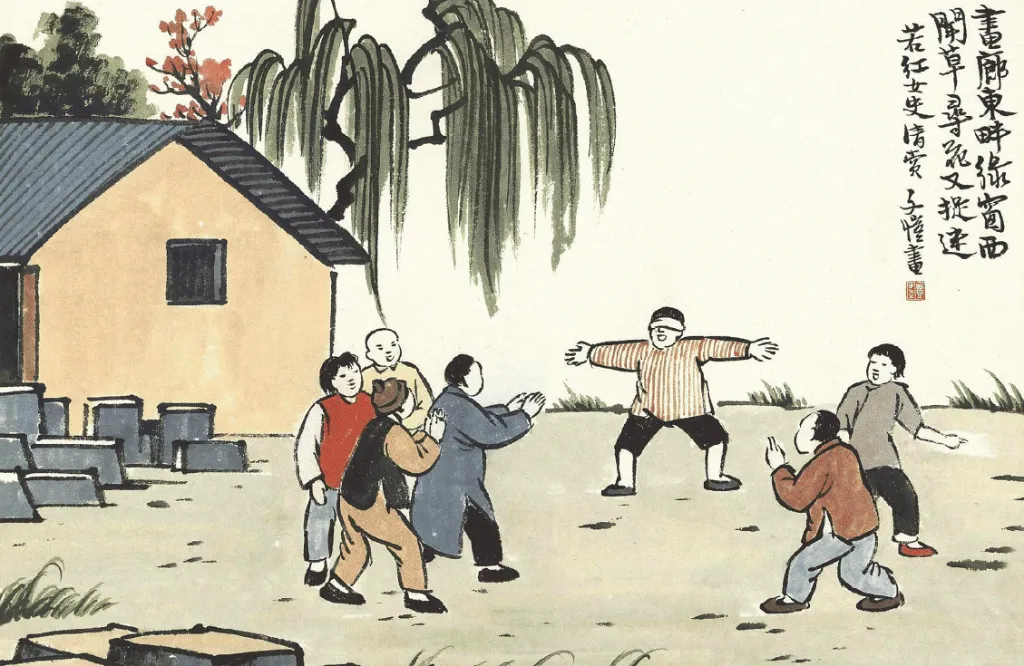
Feng Zikai was a pioneering figure in modern Chinese cartooning and a versatile artist, writer, translator, and musician. Blending Chinese literati painting with Western drawing, he used simple lines and empty space to reveal the poetry of everyday life. His 1924 work After the Guests Have Gone, a New Crescent Moon and Sky Like Water was so influential that the new art form became known as “Zikai’s Cartoons.”
Feng Zikai’s art also holds a special appeal for children. His simple lines, playful scenes, and gentle sense of humor preserve the freshness and curiosity of a child’s way of seeing the world. At the same time, his quiet compositions and generous use of empty space create a feeling of calm, inviting viewers to slow down and notice the warmth in ordinary life. To many children, Feng Zikai is not only a great artist, but also a kind, cat-loving grandfather whose pictures understand their small joys, imagination, and emotions.
Notable examples include:
- "Classical Poetry Vision" works such as After the Guests Have Gone, a New Crescent Moon and Sky Like Water and A Bosom Friend Afar Brings a Distant Land Near, which turn Tang and Song poetry into spare, modern images.
- "Children Vision" works such as Abao Has Two Legs, the Stool Has Four, When Papa Is Away, and Abao Bare-Chested, using faceless, minimal figures to depict a child's inner world.
- Destruction and Construction, a pioneering four-panel cartoon that introduced sequential storytelling to Chinese cartooning.
- "Social Vision" works such as Go to the Front, depicting wartime hardship with restrained, dignified composition.
- A Collection of Paintings for the Protection of Life, including Supporting Life and The Sound of Parting, expressing compassion for all living beings through pure ink and empty space.
Feng Zikai matters because he was among the first Chinese artists to bridge literati painting tradition and a modern visual language, drawing on Chen Shizeng's literati spirit, Li Shutong's technical training, and Takehisa Yumeji's lyrical style. He turned Chinese cartooning from satire into serious art, and turned everyday moments, wartime suffering, and compassion for living things into images of lasting emotional weight.
Ming Aretê’s lesson on Feng Zikai unfolds in two parts. Here in Part I, we return to the beginning: Feng Zikai’s childhood discoveries, the teachers and artistic traditions that shaped his distinctive voice, and his return to China to begin teaching and creating. It is the story of how a boy who loved drawing grew into one of modern China’s most beloved artists.
Knowledge Builder
Content
This part covers Feng Zikai's childhood in the dye-house town of Shimen, from reciting classical poems with his father to his first attempts at coloring and copying pictures. Through works such as his hand-colored The Great Shun Plowing the Field, his traced Portrait of Liu Zongyuan, and his enlarged Portrait of Confucius, you will see how a curious, rule-breaking boy became known as a true painter.
1.1: Feng Zikai: Part 1
1.2: Quiz
This part covers Feng Zikai's education at Zhejiang First Normal School and his study trip to Japan, where four mentors—Li Shutong, Xia Mianzun, Chen Shizeng, and Takehisa Yumeji—each shaped a different part of his art. Through works such as his Portrait of Master Hongyi and After the Guests Have Gone, a New Crescent Moon and Sky Like Water, you will see how Western technique, literary sensitivity, literati spirit, and lyrical style combined into the style known as "Zikai's Cartoons."
2.1: Feng Zikai: Part 2
2.2: Quiz
Instructor

Lucas Liu, MFA
Teaching Philosophy
He advocates student-centered teaching and designs targeted courses based on each student’s unique characteristics. Through interactive engagement, he stimulates students’ enthusiasm for creation and fosters innovative thinking. He encourages students to accumulate both successful and experimental experiences in practice, continuously expand their creative horizons, and find their own artistic paths.
Teaching Achievements
His students have been admitted to top domestic art institutions such as the Academy of Arts & Design, Tsinghua University, as well as world-renowned international art schools.
In 2019, one of his students received admission offers from 12 art institutions (including OCAD University, Emily Carr University of Art + Design, and University of Alberta—three of Canada’s top art schools) and was awarded a $4,000 scholarship from Lakehead University.
Educational Background
- Master of Fine Arts (M.F.A.) University of Wisconsin- Madison, 2015 (Full Fellowship)
- Master of Arts (M.A.) - University of Wisconsin- Madison, 2014 (Full Fellowship)
- Bachelor’s of Arts - Tsinghua University Academy of Arts & Design, 2009